Gradient

Indoor cycling for Android

Ride the plan.
The trainer does the shifting.

Gradient connects to your smart trainer over Bluetooth and sets the resistance for you: structured workouts held in ERG, rides by heart rate, and real climbs and classics with every change of grade.

Gradient is in early access: install it from Google Play and get every update as it comes. Android 12 or later. Tried it? Tell us what to build next.

  • No account
  • No subscription
  • No ads or tracking
  • Works offline

Training that holds you to the number.

Pick a workout and pedal. Gradient tells the trainer what to do, step by step, and shows you exactly where you are in it.

Workouts in ERG

Hit every interval without touching a shifter.

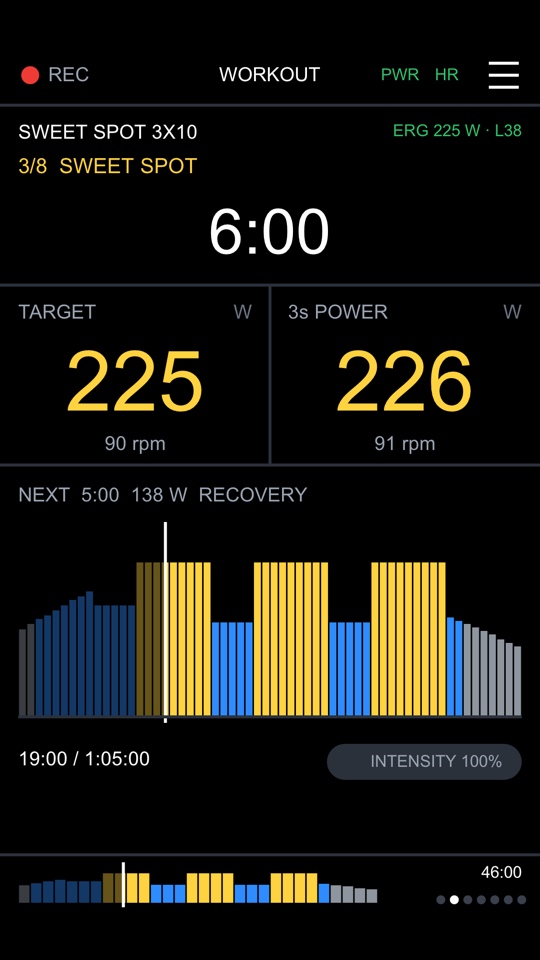
The trainer holds each step's power whatever your cadence or gear. You see the step, its target, the time left, what comes next, and the whole session in zone colors.

  • 18 ready workouts: endurance, sweet spot, threshold 2×20, over-unders, VO2 max, 30/30s, Tabata, a ramp test and a 20-minute FTP test
  • Targets in % of FTP or in watts, with ramps and cadence goals
  • Harder or easier in 5 % steps at any time, or skip to the next step
Sweet spot workout: target 225 W, 3-second power 226 W, the intervals ahead in zone colors
Heart rate training

Honest Zone 2, without chasing your pulse.

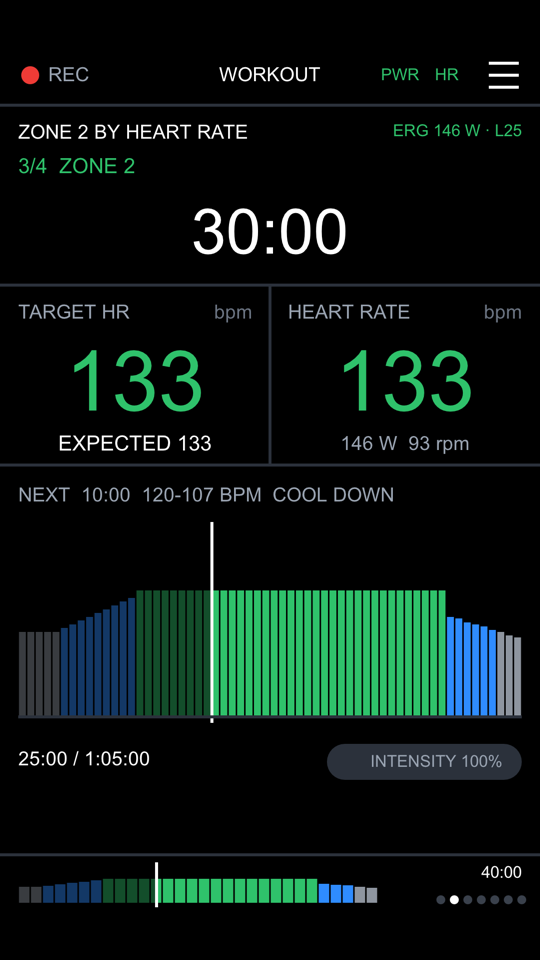
Ride by heart rate and Gradient sets the power that brings your heart into the zone and keeps it there. Because a heart lags behind the effort, it shows the heart rate you should expect by now, so you don't overshoot trying to catch up.

  • Made for long aerobic rides and aerobic intervals
  • Set your FTP and max heart rate, and the zones follow
Zone 2 by heart rate: target 133 bpm, heart rate 133 bpm at 146 W
Real routes

Feel Alpe d'Huez in your legs.

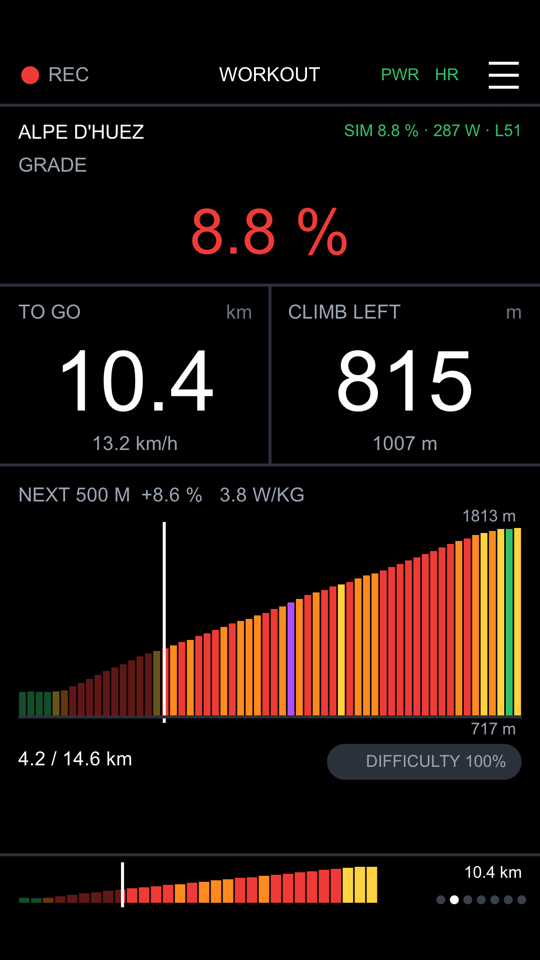
The trainer gets every change of grade, and your speed comes from your power, your weight and the road. The profile ahead is colored by grade, with the distance and the climbing left.

  • Difficulty from 0 to 150 % of the real grades
  • Draw your own routes in the free Route Builder
  • Milan–San Remo
  • Tour of Flanders
  • Paris–Roubaix
  • Liège–Bastogne–Liège
  • Il Lombardia
  • Alpe d'Huez
  • Norseman bike leg
Alpe d'Huez: 8.8 % grade, 10.4 km and 815 m of climbing to go, the profile colored by grade
Phones and tablets

Big numbers you can read mid-interval.

Power with its zone, cadence, speed, heart rate and the trainer's resistance, plus the route on a topographic map and the last five minutes as graphs. On a tablet in landscape your ride's numbers stay beside every page. The screen stays on while you ride.
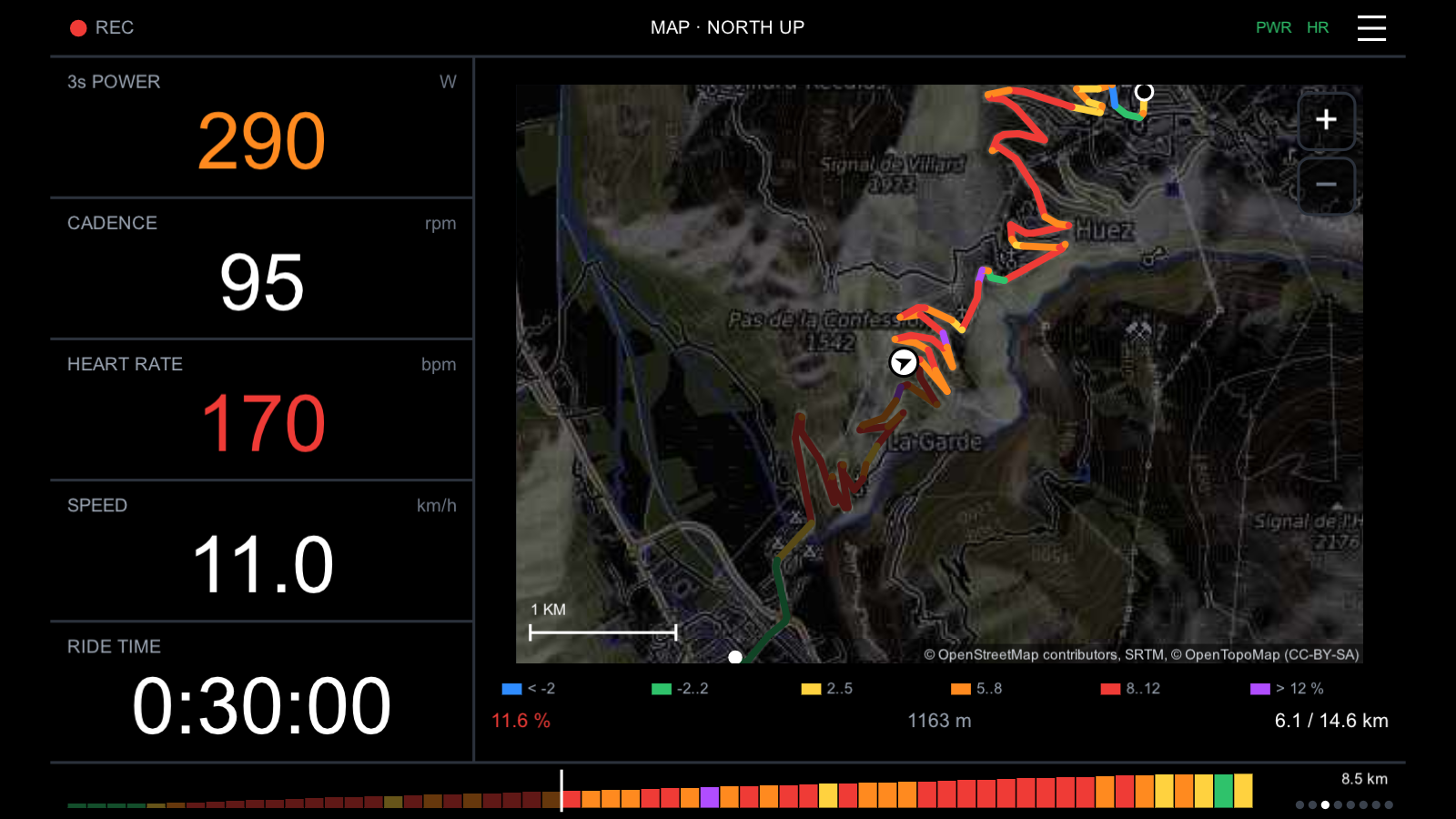
Tablet layout: power, cadence, heart rate, speed and ride time beside a topographic map of the Alpe d'Huez hairpins, the route colored by grade

Ride the route as a 3D road.

Swipe to the last page and the route you're riding becomes a road in front of you, rising where the trainer gets harder. Simple on purpose, so it runs on any phone and keeps your eyes on the effort.

3D road

The real route, bend by bend.

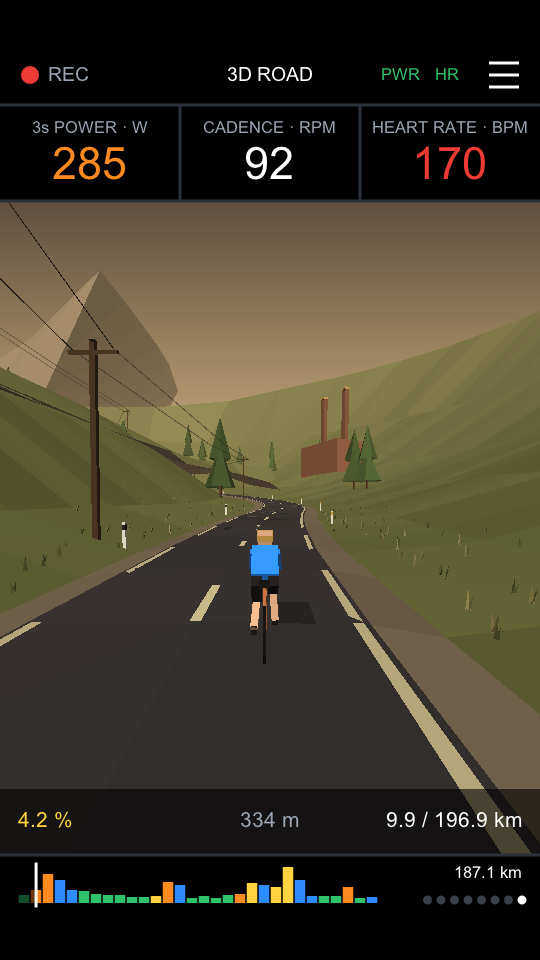
The road follows the route's map coordinates and its elevation: the hairpins of Alpe d'Huez, the climbs of Il Lombardia. Your power, cadence and heart rate stay above it, the grade, elevation and distance below.

  • Every route gets it, the ones you draw in the Route Builder too. No route? An endless road at your speed
  • Hills, pines, telegraph poles, houses, factory chimneys, kilometre stones and the odd airship
  • See it through your own eyes, or from behind a rider who pedals at your cadence
  • Your speed is what your watts and your weight give on that road, not the trainer's flywheel
3D road on Il Lombardia: a rider in blue on a winding road between hills, factory chimneys ahead, 285 W, 4.2 % grade
Pacer

Someone to chase up the climb.

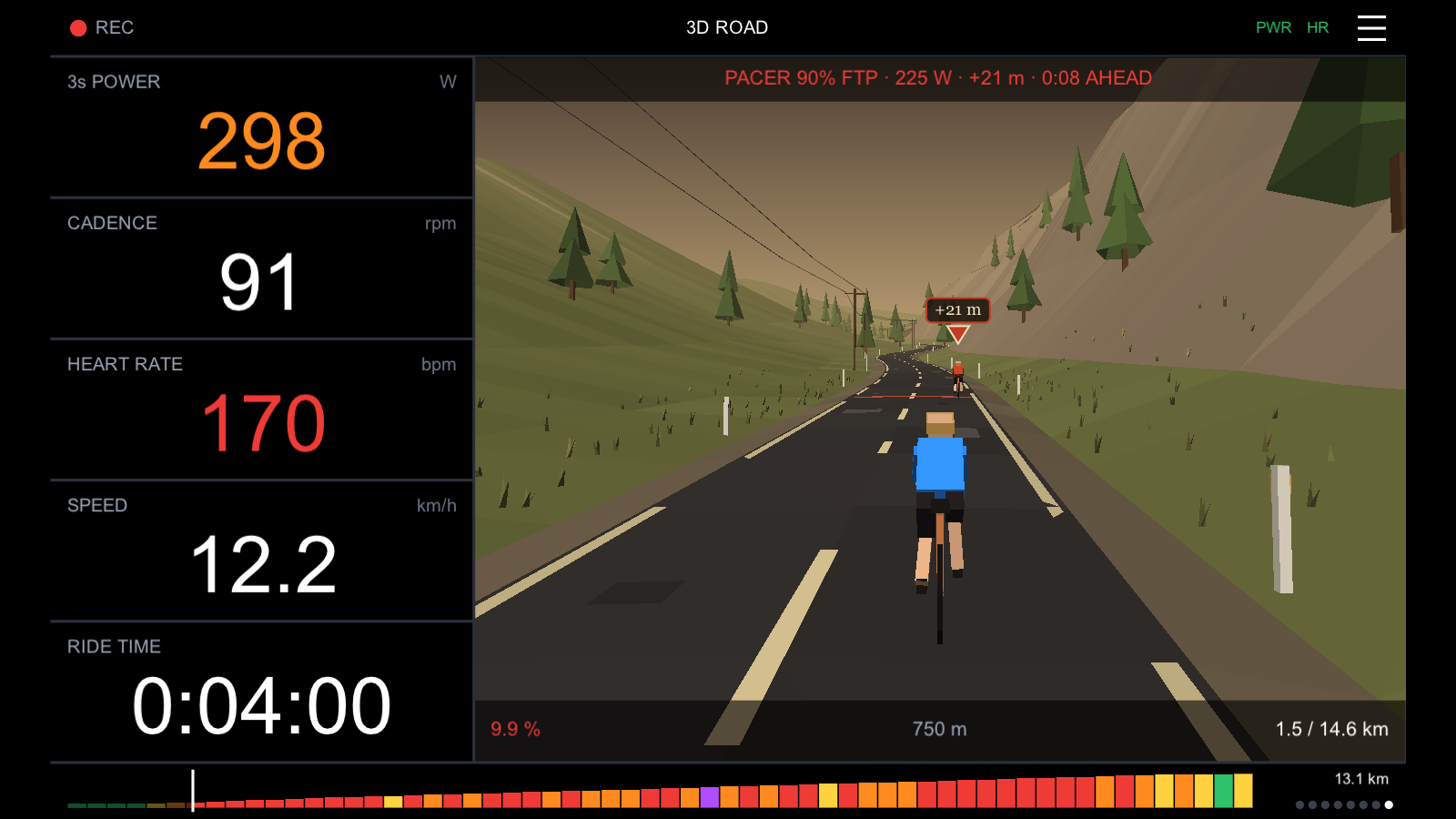
Switch on the pacer and a rider in red sets off on the same road at a power you choose, a share of your FTP or a number of watts, with a head start. It weighs what you weigh and rides the same physics, so the gap is only about the watts. You see it in metres and seconds, a marker over its head even behind a hill, and a note when one of you passes the other and who reached the finish first.

Tablet: 3D road on Alpe d'Huez with the ride's numbers on the left and the pacer 21 m ahead, marked over its head
Why it looks this way

Built for a hard hour on the trainer, not for a game console.

Every choice in the 3D road comes from what it's for: showing you where the road goes and how hard it's about to get, on a phone that's already busy talking to your trainer.

Flat shading, on purpose

Plain polygons and distance fog, like late-1990s games with their textures off, in a warm sepia. No game engine and nothing to download: the road is drawn with the same graphics as the rest of the app, in a sliver of each frame, so it runs on modest phones and works offline.

Climbs you can see coming

A real 5 % looks flat on a screen. So the road is drawn one and a half times steeper, the view tilts with the slope and the asphalt darkens the steeper it climbs: you see where the climb starts before your legs do. The numbers stay true.

A sense of speed

Marker posts every 20 m, tufts of grass on the banks, patches in the asphalt and the centre line stream past close by, so even 9 km/h up a hairpin feels like progress.

The same road every ride

The scenery is placed by the distance along the route, not at random. Ride a route again and the chimneys and the farmhouse are where you left them, so you learn it as you would a real climb.

Easy on the battery

Smooth while you ride, at 60 frames a second, and nothing at all when you stop: not a frame is drawn while you stand still.

One physics for everything

Your speed, the pacer and the trainer's resistance come from the same model of the road: the grade, rolling and air resistance, your weight and your bike's. What you see is what your legs feel.

Your rides are yours

Standard FIT files, on your phone.

Every ride is saved as a FIT file, the format of Garmin's devices, every minute while you ride. Take it to any app that reads FIT, or open it in the free Rides page for graphs, zones and best efforts.

  • Strava
  • Garmin Connect
  • TrainingPeaks
  • intervals.icu
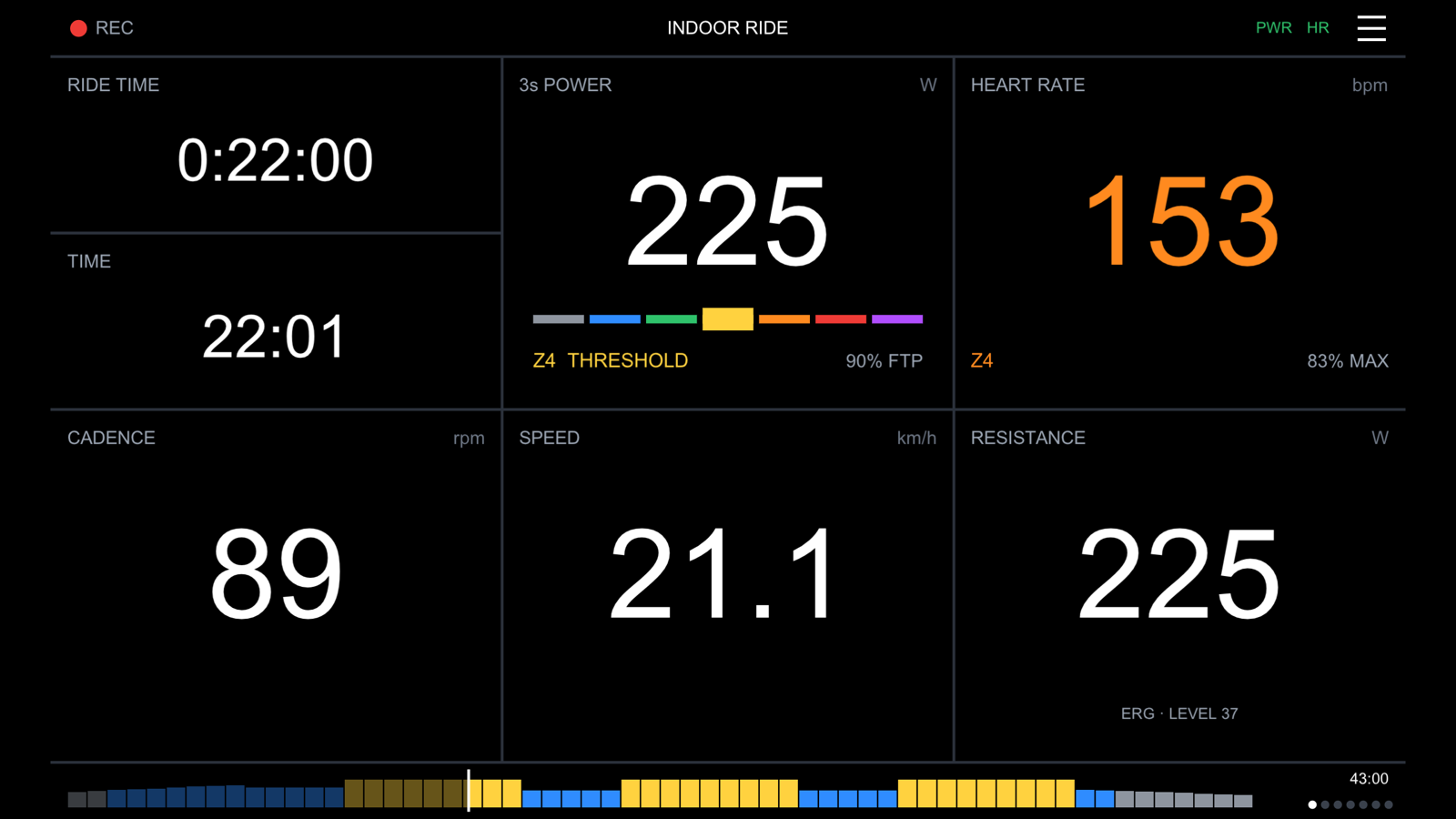
Indoor ride page: 225 W in zone 4, heart rate 153, cadence 89, speed 21.1 km/h

Works with the gear you have.

Standard Bluetooth profiles, so it isn't tied to one brand. Your sensors are remembered and connected again when you start.

Smart trainers

Any trainer with Bluetooth FTMS (Fitness Machine Service), which most current trainers support, and Tacx trainers on older firmware.

Heart rate monitors

Chest straps and armbands over Bluetooth, such as a Polar H10.

Power and cadence

Power meters and cadence or speed sensors. When two measure the same thing, you choose which one the app uses.

No account. No subscription. No ads.

Gradient doesn't need the internet and doesn't track you. Your rides, workouts and settings stay on your phone.